
Download and use of images from this site is a violation of copyright law and legal action will be pursued, unless permission has been granted by the author.
This content is based on a post originally published on June 4, 2011, on my blog “Pollinators Info” (no longer online).
I’ve had several emails from concerned folks who describe tens or hundreds of “yellow jacket” nests in their yard. It’s always a pleasure to tell them that yellow jacket wasps don’t nest that way, and that they have a nest aggregation of solitary bees!
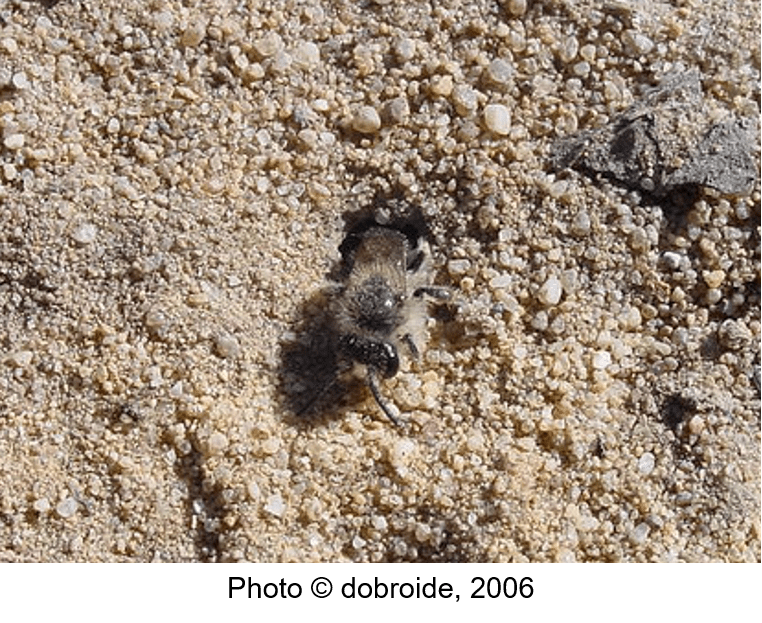
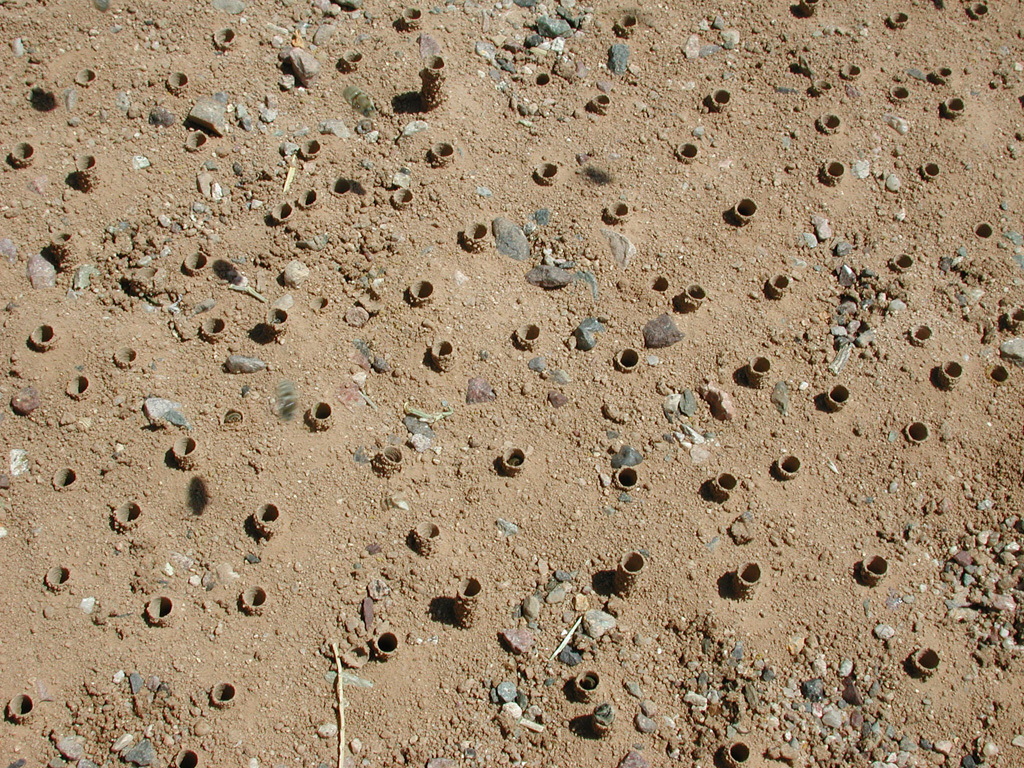
Here’s a nice photo of one female ground-nesting bee leaving her nest entrance. The featured image shows a different species of ground-nesting bee aggregation.
A yellow jacket wasp nest has one entrance, into and out of which all the wasps travel. A solitary bee nest is also a single hole, with each bee using its own entrance. An aggregation happens when tens, hundreds, or even thousands (!) of these bees nest near each other because of a good habitat. These bees need exposed soil into which to make their tunnel nests, and unfortunately, this is hard to find nowadays. When a large patch of exposed soil appears, each female bee grabs a little spot of the real estate and digs her nest, sometimes only an inch from the nests of other females doing the same.
The great news is this: they’re gentle, AND you have a rare opportunity to watch their nest-building activity! Solitary bees rarely sting- when they do, it’s usually because they became pinched in someone’s elbow or behind their knee. You could safely sit at the edge of your aggregation and watch all the busy bees without bothering them, or them bothering you. Give it a try! Take pictures and send them to me so I can post them here! Get your kids to watch with you and have fun learning about nature together.
But try not to walk or put anything heavy (like a riding lawn mower) on top of the aggregation area: inside each hole are several young developing bees that could easily be squashed. It’s also important to leave the area bare; covering it with mulch kills the developing bees and females won’t built new nests in mulch.
When you don’t see any more bees flying around and can no longer find the holes, that means that the mother bees are finished laying eggs and have covered the nest entrance. Next year at about the same time, the young bees inside will have reached adulthood and will emerge and you can watch the process again!
Have a nest aggregation in your yard? Do tell us about it, and feel free to email me photos!
Featured image copyright Mike Plagens, 2012 CC BY-NC-SA 2.0
| Download and use of images from this site is a violation of copyright law and legal action will be pursued, unless permission has been granted by the author. All images are copyright Athena Rayne Anderson unless otherwise stated. |

 Athena Rayne Anderson
Leave a comment