Download and use of images from this site is a violation of copyright law and legal action will be pursued, unless permission has been granted by the author.
This content is based on a post originally published on July 26, 2011, on my blog “Pollinators Info” (no longer online).
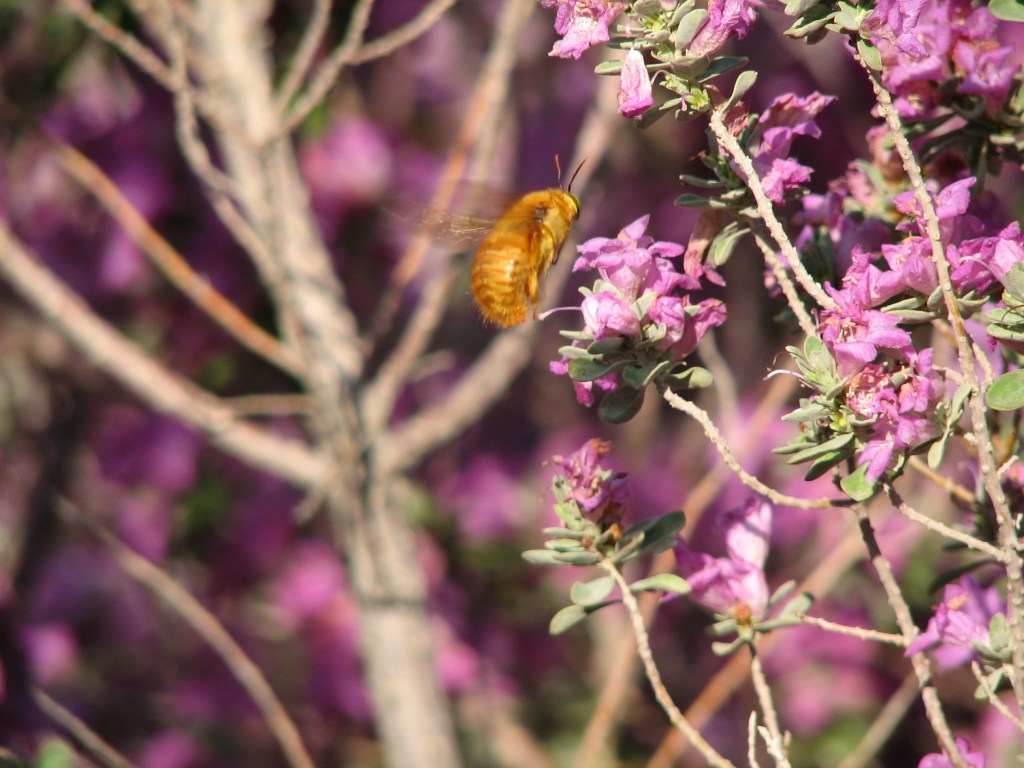
Meet the Valley Carpenter Bee, Xylocopa varipuncta. I fell for these bees while visiting El Paso, Texas, USA. What just tickled me was that the males are golden-brown with green eyes! I stood near a clump of flowering bushes in the parking lot of a gas station, giggling, watching the little golden boys chasing each other around. The other people in the parking lot looked at me like I was crazy, but I think they would have had to stare if they’d seen my little bees too! Well, maybe… here’s a video for you to see for yourself.
Why the blurry photo and video? Because the little buggers wouldn’t be still!
Anyway, this carpenter bee is common in the western U.S., and the males display typical carpenter bee territorial behavior. They claim a patch of flowers as their own, thereby securing the rights to mate with any females that enter their patch. Each male chases off anything that’s about his size, and not a female, if it gets too close to his patch.
Their vigilant watching behavior is what struck me as cute. In an evolutionary sense, it’s adaptive for a male to make sure that no other males sneak into his territory. By defending a territory, a male can potentially mate with more females than he would if he did not defend a territory. If a male defends a high-quality territory, he’s also more likely to mate with many females than if his territory is of low quality.
What’s a high-quality territory, you ask? One with flowers that females want to visit! The females choose which males they will allow to mate with them.
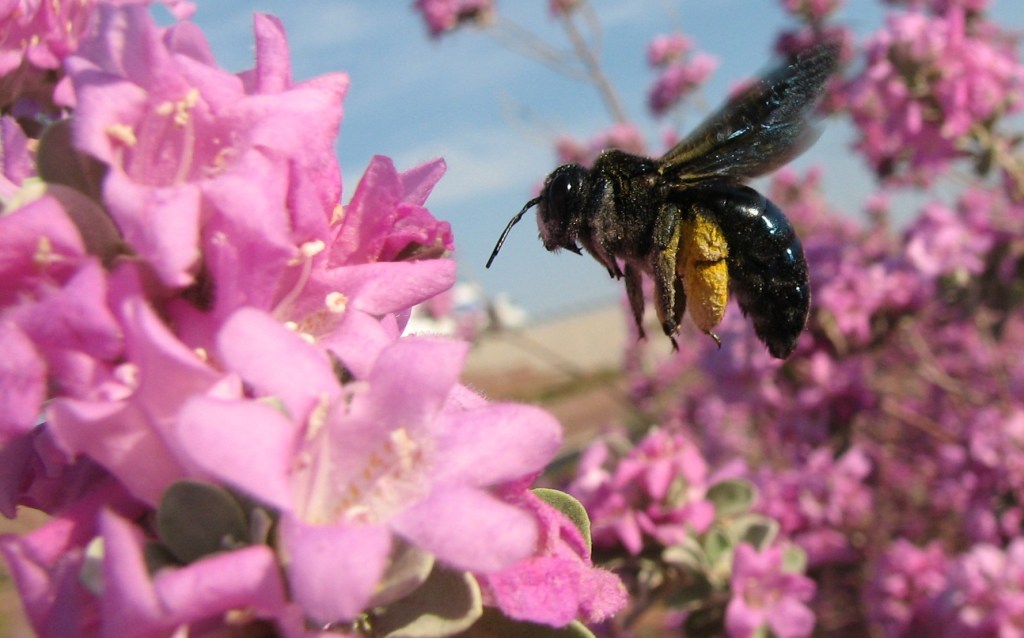
Female Valley Carpenter Bees are important pollinators of many southwestern plants. Here’s a photo of a female (notice that she has yellow pollen on her rear leg scopa).
It’s all based on the principles of natural selection. But I couldn’t help a little anthropomorphism, and you can hear me trying not to laugh in the video above.
Have you seen this bee? Where do you live? What was it visiting? Do males defend territories in your yard? Tell us about it here!
| Download and use of images from this site is a violation of copyright law and legal action will be pursued, unless permission has been granted by the author. All images are copyright Athena Rayne Anderson unless otherwise stated. |

 Athena Rayne Anderson
Leave a comment