

Download and use of images from this site is a violation of copyright law and legal action will be pursued, unless permission has been granted by the author.
This content is based on a post originally published on May 29, 2011, on my blog “Pollinators Info” (no longer online).
In much of North America, this is a common question. Bumble bees and carpenter bees have very similar black-and-yellow color patterns, and are both large and robust. What difference does it make if you can tell them apart? Well, getting to know your local pollinators can not only be fun, but can help you tailor your garden plans, see which bees are using your property, educate others, and figure out if that bee is looking to chew into your wooden siding.
Is it a bumble bee or a carpenter bee?
Bumble bees and carpenter bees have very different lifestyles. Bumble bees are social, with each nest containing the mother (queen) and her daughters (workers). They tend to nest in the ground, grass tussocks, or any protected place with a soft, insulative material.
Carpenter bees are solitary, meaning that the mother lays eggs and leaves them with enough food to survive to adulthood. These bees are powerful chewers and excavate tunnels in soft wood for their nests. Sometimes many adult carpenter bees will rest together in the same tunnel, but they aren’t cooperating to raise young or find food.
Male bees can’t sting, but male carpenter bees have the unnerving habit of approaching people. These little guys are very territorial and can be seen trying to chase off most other flying things inside their territory. They might fly up to you out of curiosity and hover back and forth in front of your face or nearby. If you live in the southeast and stand still and look back at them, you’ll see a yellow patch between their eyes that identifies them as males of the species Xylocopa virginica. They’ll fly away eventually, but if you don’t want to stand around waiting for them to do so, you could just ignore them and go about your business. Female carpenter bees don’t act this way- they can sting, but they’re so busy they’ll usually pay no attention to you.
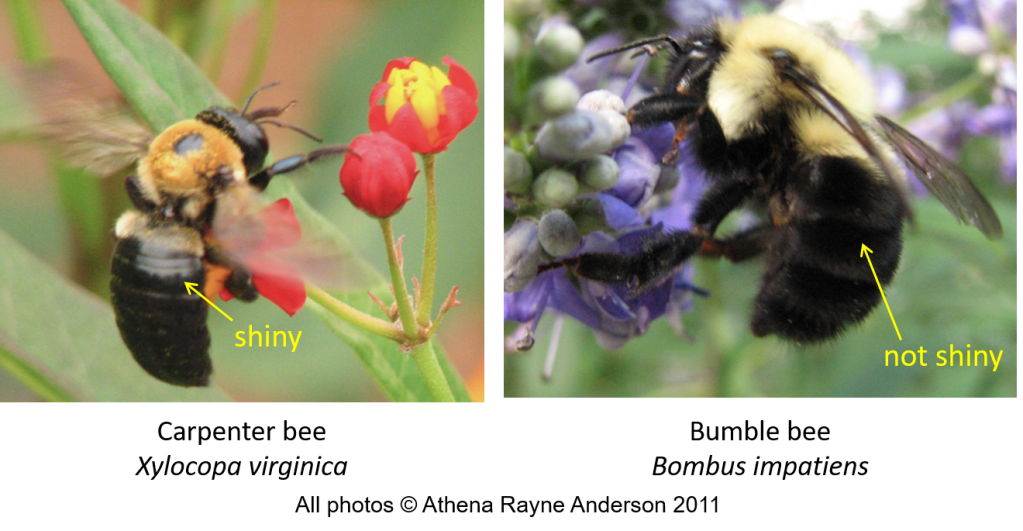
So, how to tell a bumble bee from a carpenter bee? The easiest way for folks in most of North America who are new to this is to see whether the abdomen looks shiny or not. Have a look at the photos above. Does light reflect off the abdomen surface? If YES, you’re looking at a carpenter bee. If NO, it’s a bumble bee. Bumble bees are fuzzy, and their abdomens don’t look shiny as a result of all the hair.
Once you get used to distinguishing these two bee groups, you’ll also start to notice that carpenter bees have wider heads than bumble bees, which is necessary to accommodate their large mandible muscles. Both male and female carpenter bees of the species Xylocopa virginica have a prominent round hairless black patch on their thorax, between the wings. You can see this in the image above.
| Download and use of images from this site is a violation of copyright law and legal action will be pursued, unless permission has been granted by the author. All images are copyright Athena Rayne Anderson unless otherwise stated. |

 Athena Rayne Anderson
Leave a comment