
Download and use of images from this site is a violation of copyright law and legal action will be pursued, unless permission has been granted by the author.
This content is based on a post originally published on May 16, 2011, on my blog “Pollinators Info” (no longer online).
The short answer is: probably not!
Here are a couple of photos with bees on my hands- the left is a little sweat bee, and the right is a very large bumble bee.
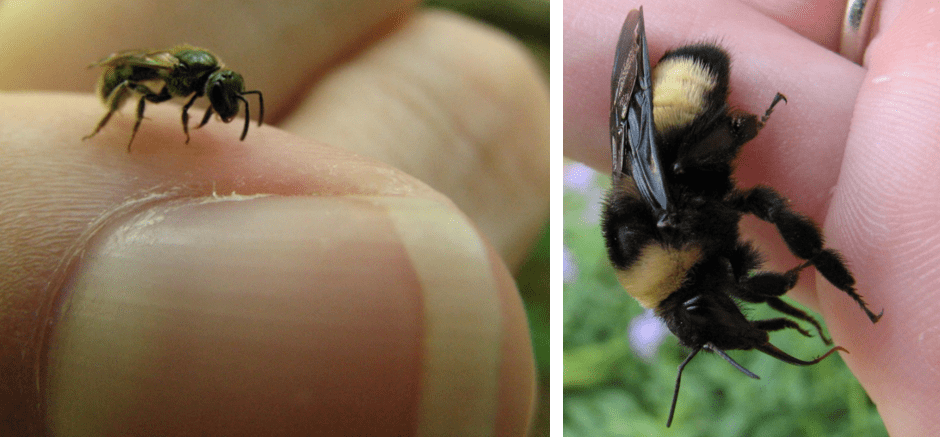
Many people tell me they’re not sure they want to attract bees to their yards because they worry about themselves or their children being stung. I’ve got great news for you: native bees are very gentle. All female bees are capable of stinging, but most won’t unless they’re in immediate danger. For example, many people are familiar with sweat bees that land on your skin and walk around lapping up the salts in your perspiration. If left unharmed, these bees will drink their fill and fly off; you only get stung if you squash them! This could happen if, for example, one was behind your knee and you didn’t know it and bent to sit down (this happened to me).
Most of what people know about bees is about honey bees, which often sting with enthusiasm in defense of their nests. A couple of reasons for this behavior is that honey bees have large stores of food (honey) and many offspring to protect. Their livelihood depends on keeping intruders away from their hives. Native bees, on the other hand, are mostly solitary and nest in holes in the ground or stems. They do not store large quantities of food, and have few offspring in each nest. In an evolutionary context, it is not to the solitary bee’s advantage to be aggressive in nest defense, because starting a new nest requires less energy.
Yellow jacket wasps (Vespula) are often confused for bees in the southeastern U.S. One of the most common stories I hear to justify the fear of bees nesting in their yard is that a bunch of bees chased someone across their property. Native bees in the U.S. don’t do this, but honeybees and yellow jackets will!
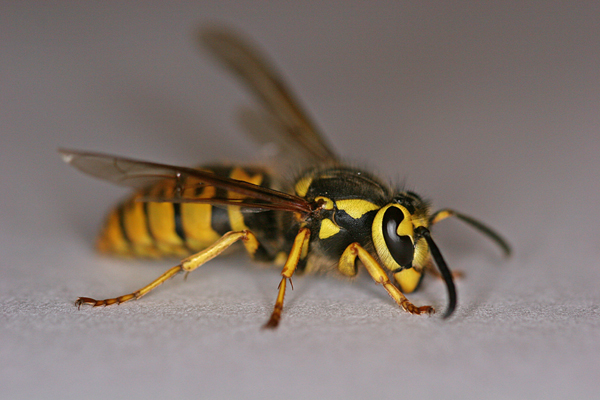
This photo shows a yellow jacket, which is a social paper wasp that usually nests in the ground.
Image copyright Bombman356, April 17, 2007, CC BY-SA-3.0
Yellow jackets look similar to some bees and other wasps, but the combination of coloration, ground nesting habits, and tendency to chase anything that disturbs their nest will help you identify them.
So, you have little to fear from our native bees. Even if you are lucky enough to have hundreds of bees nesting in holes in your yard, you could walk over top of the entire congregation (this is what we call it when they nest near each other) and not get stung. I wouldn’t advise doing so, however, because you wouldn’t want to crush the developing bees beneath the surface!
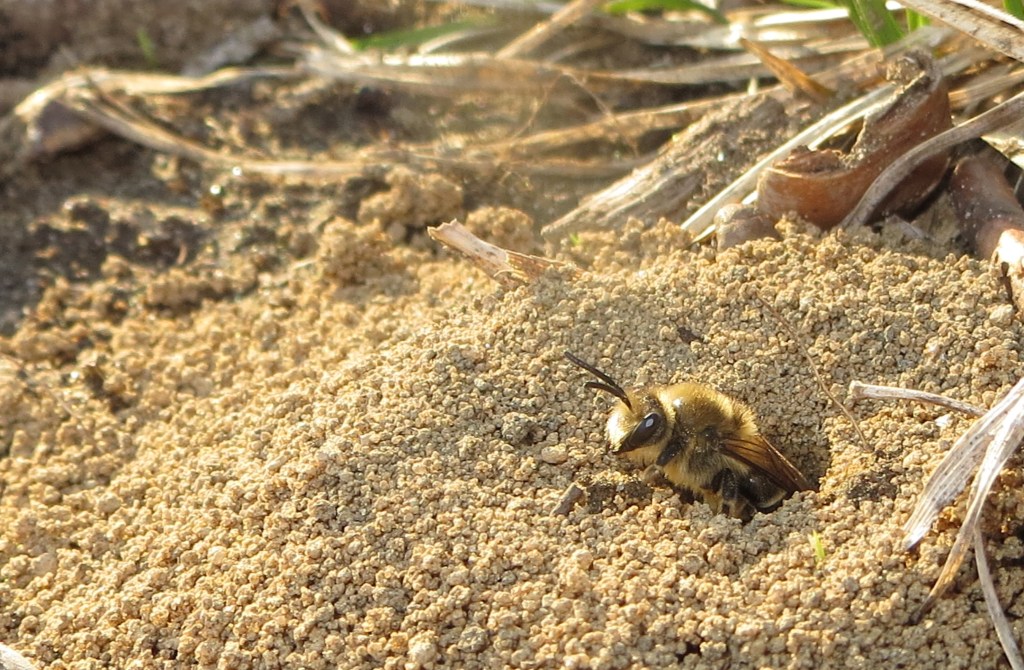
Featured image copyright Cornell IPM Program at Cornell University July 28, 2014 CC BY-NC-SA 2.0
| Download and use of images from this site is a violation of copyright law and legal action will be pursued, unless permission has been granted by the author. All images are copyright Athena Rayne Anderson unless otherwise stated. |

 Athena Rayne Anderson
Leave a comment