
Download and use of images from this site is a violation of copyright law and legal action will be pursued, unless permission has been granted by the author.
This content is from posts originally published on May 15 and May 29, 2011, on my blog “Pollinators Info” (no longer online).
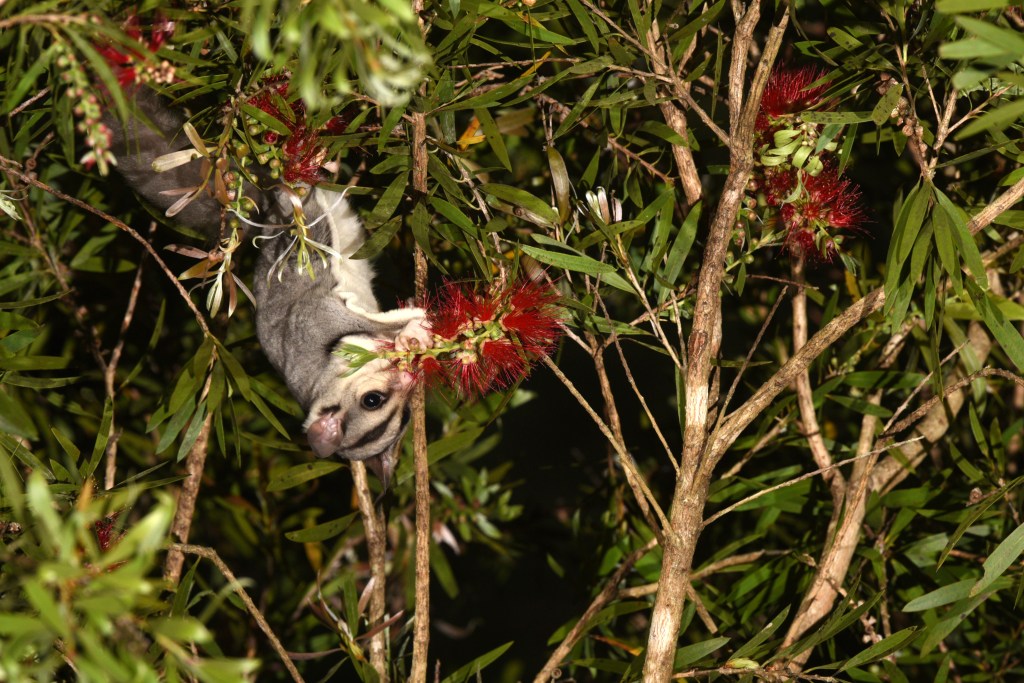
Small mammal pollination isn’t globally common, but is an important component of some ecological communities. For example, marsupials like sugar gliders and honey possums are pollinators in Australia. These little mammals climb on and poke their faces into flowers looking for nectar. In the process, pollen sticks to their fur and is transferred to the next flower they visit. The featured image shows a sugar glider clinging to a flower as it feeds.

In Africa, mice have recently been discovered as pollinators; so has this little animal pictured here. Its common name is “elephant shrew,” but it’s more closely related to elephants than shrews!
Even though it looks like a mouse, its long and flexible nose is characteristic of the rare Family Macroscelididae, found only in Africa. This photo was provided with permission by Dr. Petra Wester, who studies small mammal pollination in South Africa.
Flowers that are mostly pollinated by small mammals tend to be inconspicuous, grow near the ground, and smell slightly sour. If other animals are more common pollinators, flowers might fit a different pollination syndrome.
Featured photo copyright Dash Huang, March 4, 2019, CC BY 2.0.
| Download and use of images from this site is a violation of copyright law and legal action will be pursued, unless permission has been granted by the author. All images are copyright Athena Rayne Anderson unless otherwise stated. |

 Athena Rayne Anderson
Leave a comment