
Download and use of images from this site is a violation of copyright law and legal action will be pursued, unless permission has been granted by the author.
Part of this post was originally published in May 15, 2011, on my blog “Pollinators Info” (no longer online).
The idea of pollination syndromes has been around for a long time, predicting that plants with certain characteristics are pollinated by certain animals. When we look at flower color, scent, structure, and the time of day in which it opens, we can generally predict the types of pollinators that will be its most common visitors.
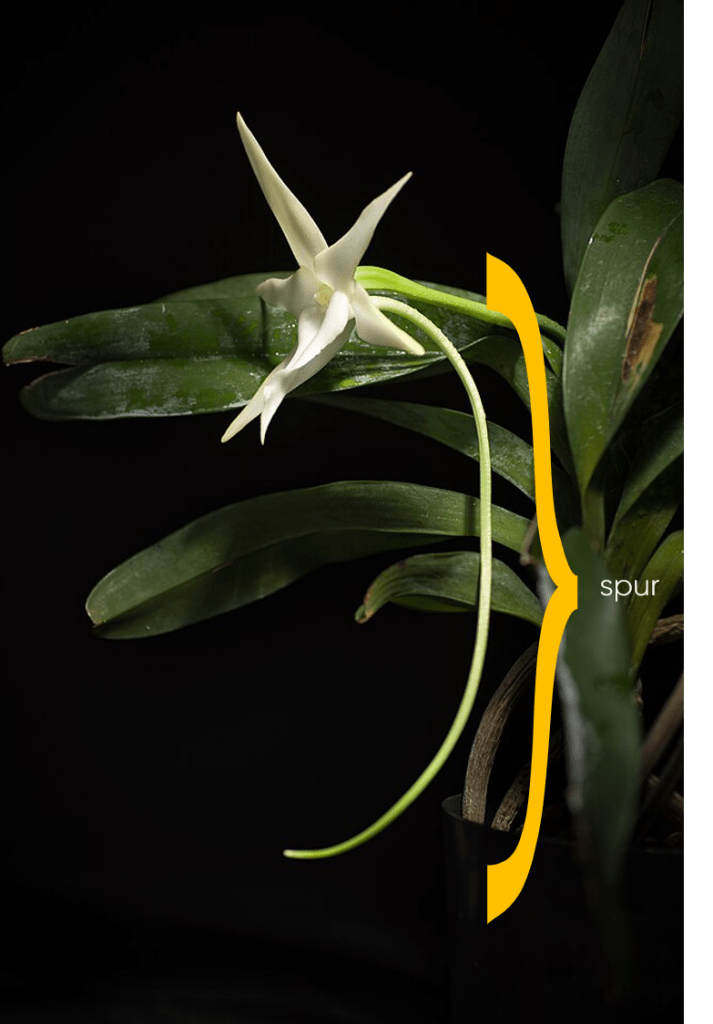
Here’s a fun example of how this knowledge can be useful. The flower shown here is native to Madagascar and is now commonly known as Darwin’s orchid (Angraecum sesquipedale). The man himself discovered this species during his global adventures and described it in 1862 in his publication Fertilisation of Orchids.
Image copyright sunoochi, December 24, 2018 CC BY 2.0, modified with label.
Notice the long spur, which I’ve labeled with an orange bracket. This structure is a tube made of fused petal (corolla) tissue, usually containing nectar at the tip. The opening of this orchid is in the center of the white petals, at the top of the image. The spur in this species can be up to 18″ long! At the time of this orchid’s discovery, the plant’s pollinator was unknown to science.
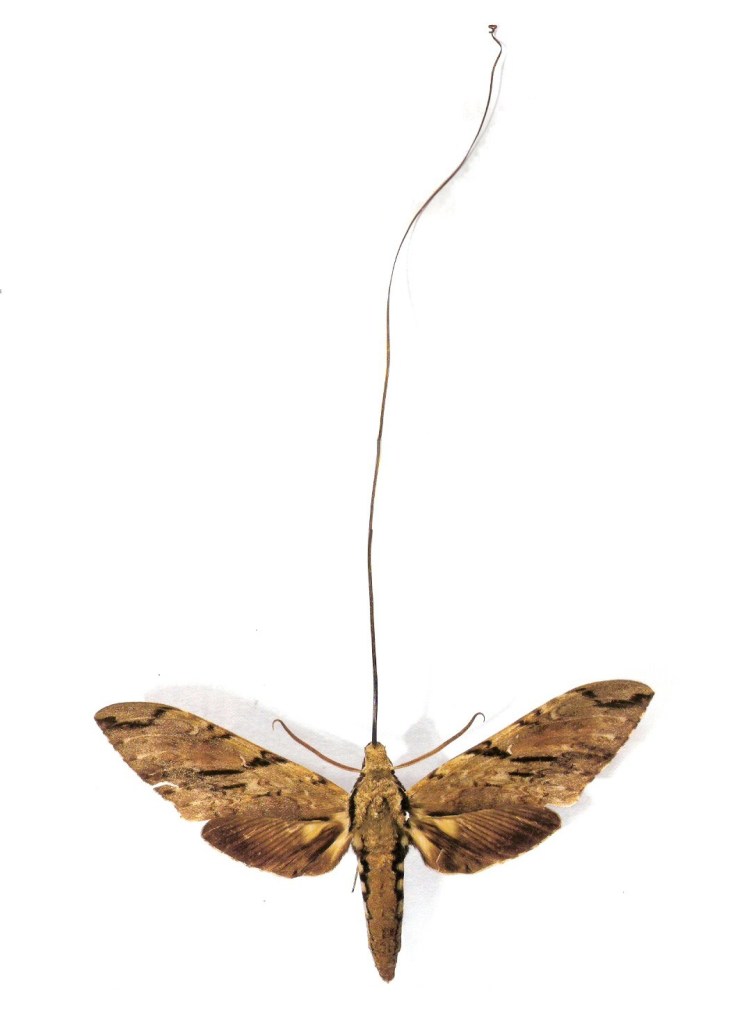
In the article describing the species, Darwin predicted we would eventually discover its pollinator to be a moth with a tongue (proboscis) to approximately match the spur lenth. The scientific community scoffed at this but, in 1903, over 20 years after Darwin’s death, the moth was discovered: Xanthopan morganii. This species (shown here) has a proboscis that is the longest among insects and can range from 6″ – 11.”
Image copyright Esculapio, March 18, 2010 CC BY 3.0.
New research suggests the relationships between plants and their pollinators are more complicated than originally proposed. Some pollinators can be found visiting flowers that aren’t their “type.” One of the most important rules in biology is that there are exceptions to every rule! However, I think the concept of pollination syndromes is great for helping people learn to recognize generalities among plants and their pollinators.
For an in-depth discussion of pollination syndromes, explore this article in the Annals of Botany: Pollination Syndromes and the Origins of Floral Traits.
Featured image courtesy of Pixabay free photos.
Reference: Kritsky, G. 2001. Darwin’s Madagascan hawk moth prediction. American Entomologist 37: 206-210.
| Download and use of images from this site is a violation of copyright law and legal action will be pursued, unless permission has been granted by the author. All images are copyright Athena Rayne Anderson unless otherwise stated. |

 Athena Rayne Anderson
Leave a comment