
Download and use of images from this site is a violation of copyright law and legal action will be pursued, unless permission has been granted by the author.
This post was originally published in January 16, 2012, on my blog “Pollinators Info” (no longer online).
Scorpionflies did it before birds or bees!
Fossils suggest scorpionflies might have been some of Earth’s first pollinating animals!
Scorpionflies are a neat group of insects. Their order, Mecoptera, means “long wings,” and their common name comes from the scorpion-like appearance of male genitalia in some species. But, they’re neither scorpions, nor flies! Most living species are predatory or eat decaying matter.
If you’ve never seen one, they’re odd-looking; in addition to the scorpion-like back end (in males), they have fly-like wings, and a long “face.” I saw my first when I was a kid, and I thought, “Hmmm… something weird about that bug!” I photographed the female in the featured image in Great Smoky Mountains National Park (USA), where she had been nibbling on someone’s discarded animal cracker.
Scorpionflies have a long evolutionary history, with some of the oldest fossils dating back to the mid-Jurassic, about 168 million years ago! Research published in SCIENCE in 2009 documented evidence from newly-discovered scorpionfly fossils that offer clues to early insect pollination.
Fossil evidence suggests that flowering plants (angiosperms) evolved in the early Cretaceous, around 145 million years ago. Insect pollination was thought to have evolved around the same time, based on fossil records of bees, butterflies, and other pollinators.
New fossil discoveries of extinct scorpionflies suggest these insects drank from and pollinated gymnosperms (non-flowering plants like pines) long before flowers evolved! The long, straw-like mouthparts of the fossil scorpionflies resemble those of living nectar-drinking inescts like butterflies and long-tongued flies.
Fossil insects from the mid-Jurassic have been found to contain nectar-like fluid in their guts. Scientists have also found fossilized gymnosperm reproductive features, like tubes and pores on the ovaries, that suggest that they offered a reward to visitors. The 2009 discovery of new fossil scorpionflies also provides evidence that these, and possibly other insects, were pollinating plants long before other animals started doing the same!
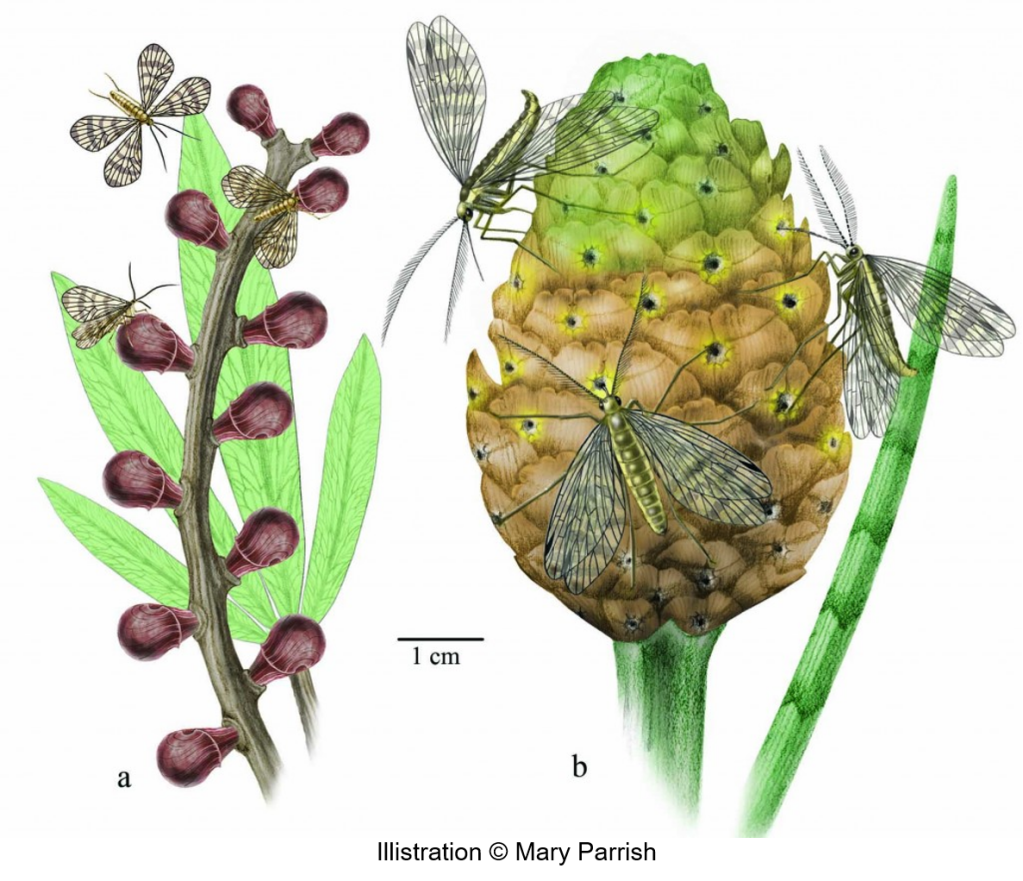
This illustration below, by Mary Parrish, shows an example of what the newly-discovered scorpionflies might have looked like while pollinating gymnosperm cones.
Read the SCIENCE article about these extinct scorpionflies: A probable pollination mode before angiosperms: Eurasian, long-proboscid scorpionflies.
| Download and use of images from this site is a violation of copyright law and legal action will be pursued, unless permission has been granted by the author. All images are copyright Athena Rayne Anderson unless otherwise stated. |

 Athena Rayne Anderson
Leave a comment