Download and use of images from this site is a violation of copyright law and legal action will be pursued, unless permission has been granted by the author.
This post was originally published on May 13, 2011, on my blog “Pollinators Info” (no longer online).
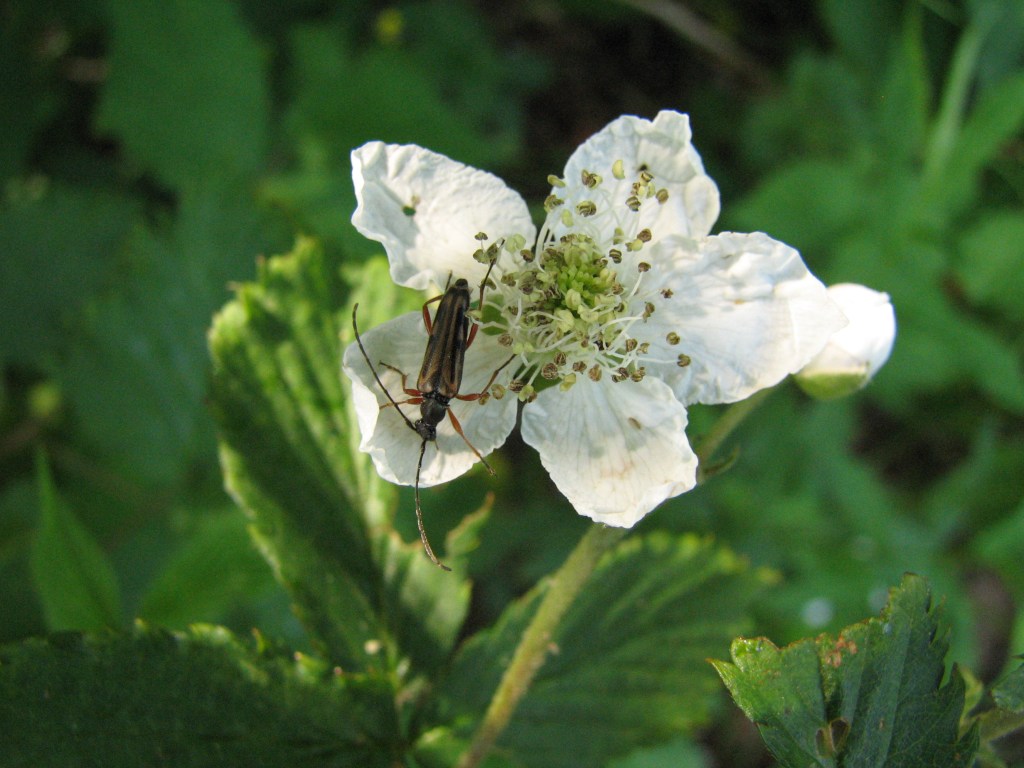
In brief, pollination is the transfer of pollen from an anther to a stigma. But what does all that mean? To understand it fully, we need to go into a bit of plant reproductive biology…
Not all plants reproduce sexually, but the most conspicuous ones do- including your garden flowers, trees, and grasses. This means that, at the basic level, reproduction in these plants is similar to that in humans. Male genetic material is carried in sperm, and female genetic material is carried in eggs. You can think of pollen as a kind of “delivery vessel” for sperm.

Pollen is produced in a structure on the plant called an anther, and eggs are held inside a female structure called an ovary. The ovary has a stalk-like style, and a tip called a stigma. The stigma is commonly sticky in some manner to encourage pollen to stay put once it gets there. In non-flowering plants (called gymnosperms) like pines, these structures are exposed to the air and are difficult to identify. In flowering plants (called angiosperms), they are protected by an identifiable flower, like a rose for example.
What happens once the pollen reaches the stigma? Ta-da! That’s the moment of pollination! Fertilization happens later, once the sperm in the pollen grain travels into the ovary and joins with an egg cell.
| Download and use of images from this site is a violation of copyright law and legal action will be pursued, unless permission has been granted by the author. All images are copyright Athena Rayne Anderson unless otherwise stated. |

 Athena Rayne Anderson
Leave a comment