
Download and use of images from this site is a violation of copyright law and legal action will be pursued, unless permission has been granted by the author.
This post is part of an article I submitted for publication with a Georgia magazine called “Coastscapes” in 2010-2012. I’ve been unable to find this magazine online, but want to share the content for your educational enjoyment. The magazine was geared towards the general public, so there are no references to research articles. Feel free to contact me if you’d like help finding references for any of the content! All images that are not my own are used with permission.
Bees are superstar pollinators all over the world! While all pollinators are important, bees as a group are usually the most effective pollinators in a given habitat. There are several reasons for this:
- Bees evolved with flowering plants about 220 million years ago, so they’ve had a long time to adapt to using flowers as a food source.
- Bees are completely dependent on nectar and pollen from flowers for food, which means that they visit a lot of flowers in their lifetimes.
- Bees’ bodies are covered with branched hairs that attract and hold pollen.
- Female bees have special body parts, called scopae (singular= scopa) into which they stuff loads of pollen. A scopa looks like a bushy area on the bee’s hind legs or under her abdomen.
The vast majority of the world’s bees are solitary, meaning that they do not live in large hives like honey bees. Solitary bee females lay eggs and die before their offspring hatch. Most bees nest in tunnels they dig in the ground, and some nest in stems or abandoned beetle tunnels in tree trunks. One of the best things you can do to help conserve native bees is to provide nesting habitat for them in the form of bare ground patches and wooded areas.
There are over 4,000 species of bees native to the United States, and an estimated 380 of these are found in Georgia! Unlike honey bees, these carpenter bees, bumble bees, blueberry bees, and others evolved in North America and are specially adapted to local environmental conditions and native plants. Unlike honey bees, native bees are very gentle and won’t sting unless in immediate danger, like from being squeezed between your skin and clothes.
Common Native Bees in the Georgia Coastal Plain
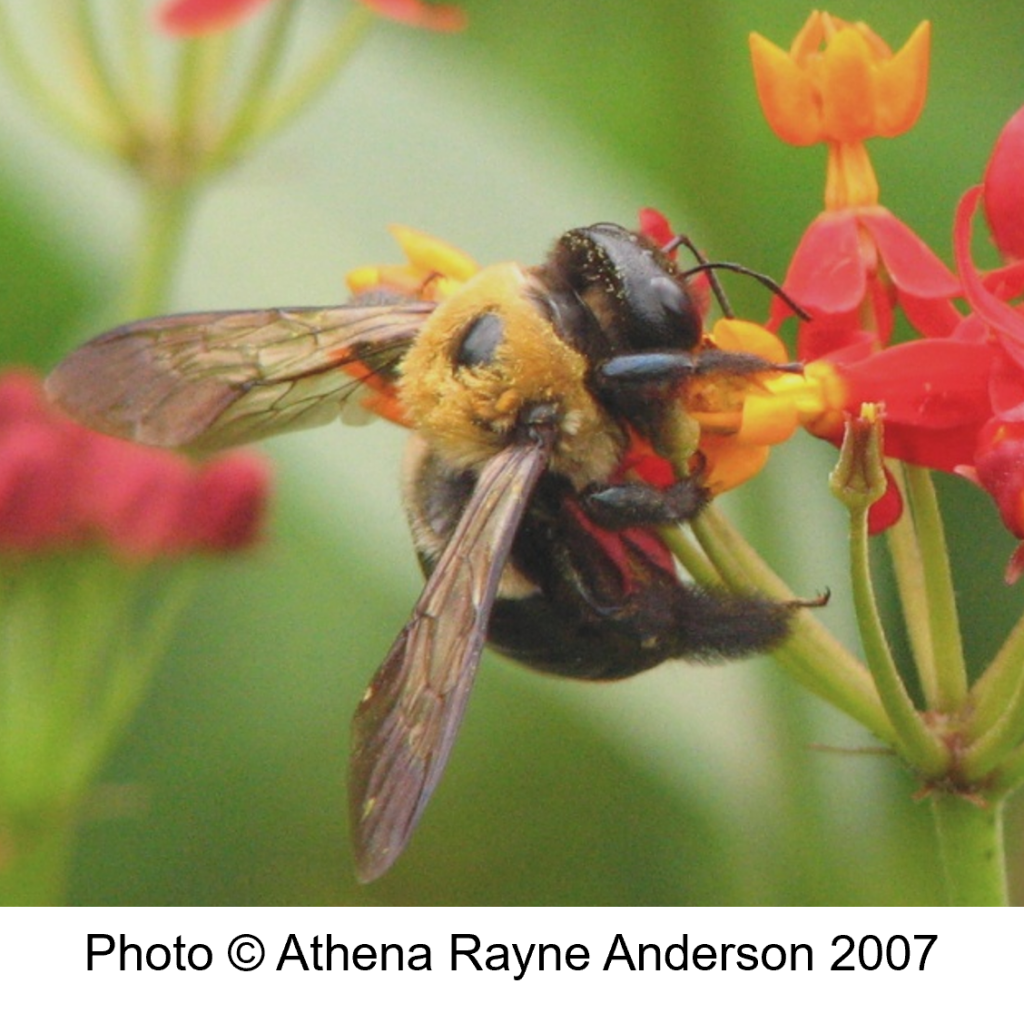
Carpenter Bees
Xylocopa virginica
These bees are some of the largest in the area (greater than 1” long), and are easily confused with bumble bees, which are similar in size and color.You can tell them apart by looking at the head and abdomen: carpenters have wide heads and hairless abdomens that look shiny in the light. The wide head accommodates large muscles that females use to chew nesting tunnels into soft wood.
These bees are commonly found nesting in wooden house siding or outdoor furniture, due to a lack of natural habitat. Carpenter bees will visit almost any large flower (they tend to avoid very small flowers), and females collect pollen in a scopa on their hind legs. You can find carpenter bees flying from early spring into fall. Males have a characteristic territorial behavior of flying back and forth (patroling) a patch of flowers or nesting habitat, and chasing off anything that’s not a female carpenter bee and about their size.
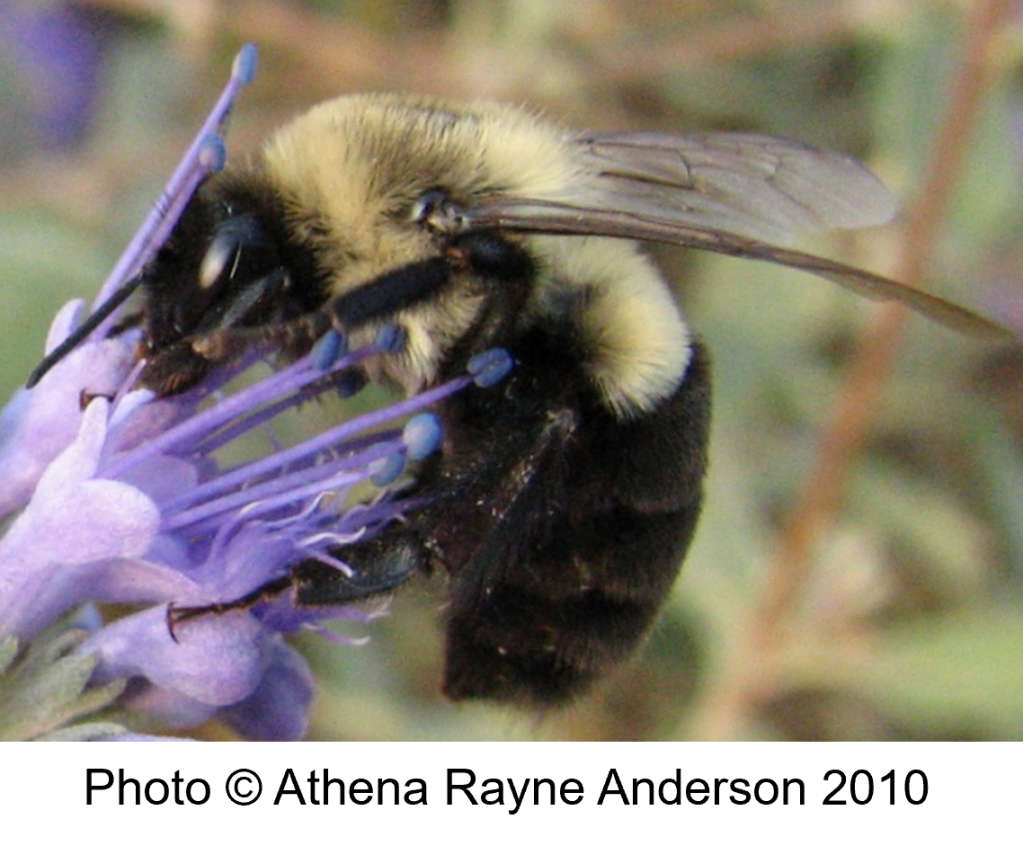
Bumble Bees
Genus: Bombus
Several bumble bee species are native to the Georgia coastal plain, but they all look very similar to the one pictured here. These bees vary more in size than carpenter bees- you can find workers the size of house flies, and queens nearly 2” long! You can tell bumble bees from carpenter bees by comparing the head and abdomen: bumble bees have narrow heads and fuzzy abdomens that are not shiny in the light.
Bumble bees are one of the few groups of native bees that are social; they nest in hives with a queen and workers, similar to the situation with honey bees. However, bumble bee nests only contain 10s or 100s of workers, while honey bee nests can have more than 30,000 workers. Bumble bees nest in abandoned rodent burrows, leaf piles, or grassy tussocks. They tend to visit the same kinds of flowers as carpenter bees, and they especially like flowers that are blue, white, or yellow. Females have a special type of scopa, called a corbiculum, on their legs. A carpenter bee carrying lots of pollen will look like she has yellow fur on her hind legs. But a bumble bee carrying lots of pollen will look like she has a yellow ball on each hind leg, just like a honey bee does when she carries pollen. Bumble bees are active from early spring into fall.
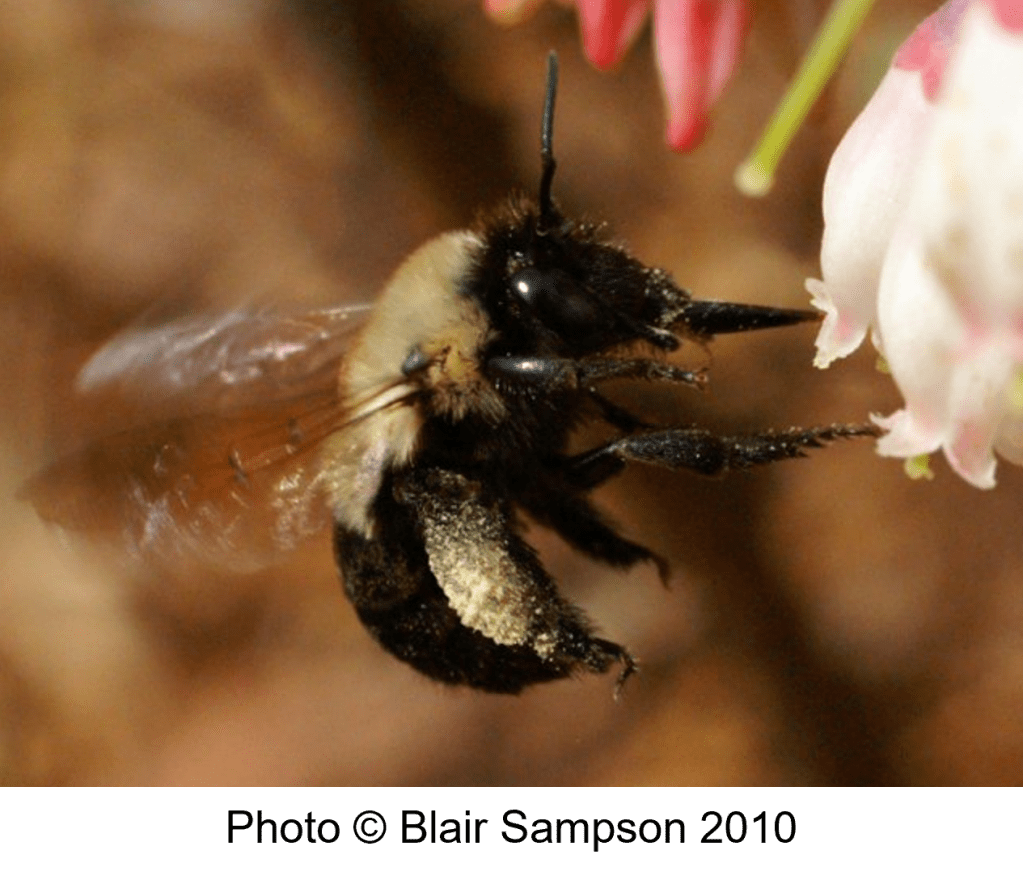
Southeastern Blueberry Bees
Habropoda laboriosa
These bees are unique to the coastal plain region of the southeastern U.S. They tend to be about honey bee-sized, and look very similar to a bumble bee in coloration. However, as you can see in the photo here, females carry pollen in a scopa on their hind legs, just like carpenter bees. If you see a small bee with a fuzzy abdomen and its scopa on its hind legs, it’s probably a blueberry bee. Like their name suggests, these bees are specialists on blueberries, and are more efficient at pollinating these crops than honey bees! Females nest in bare, sandy soil, and these bees are only active during blueberry bloom- usually very early in spring.
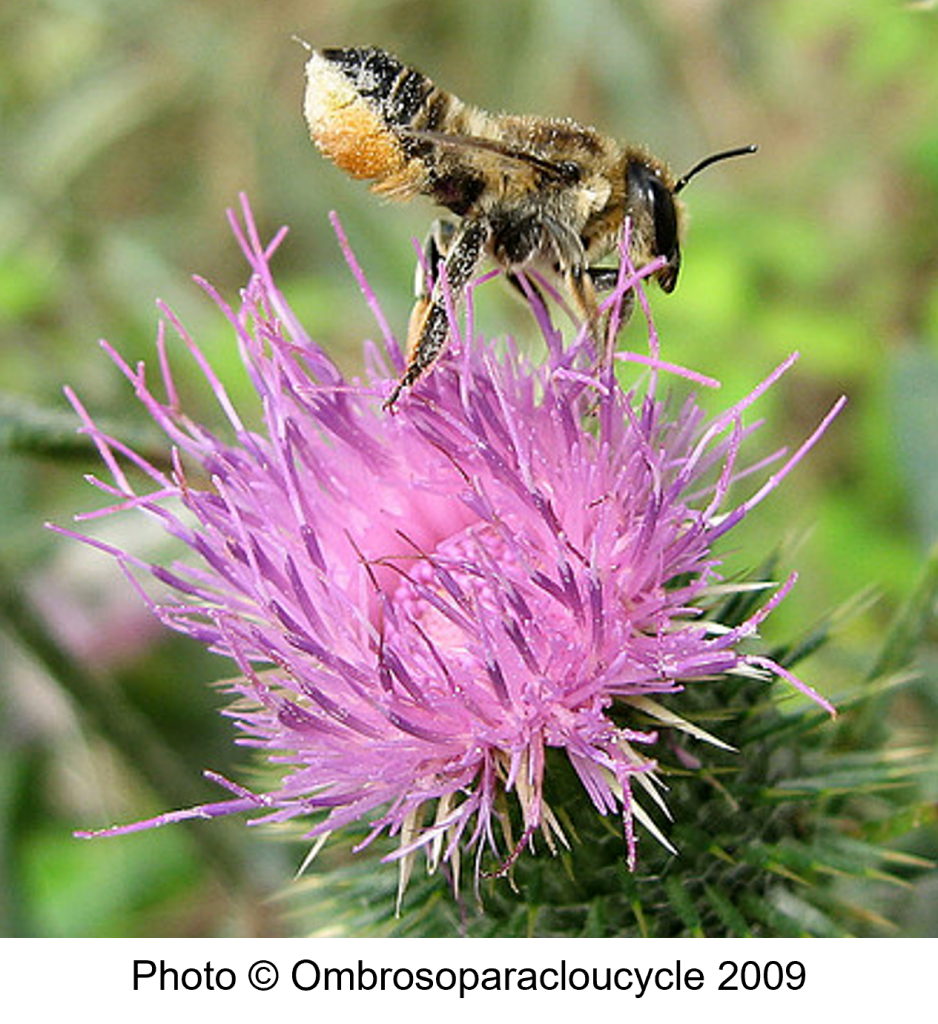
Leafcutter Bees
Family Megachilidae
There are several species of these bees in Georgia, and they tend to be honey bee-sized and smaller. The best way to recognize them is by their habit of holding their abdomens in the air, like the female in this photo is doing. These are also the only bees that have a scopa on the underside of their abdomens. In this photo, the scopa looks yellow-orange. These bees nest in stems and twigs, and females cut circular segments of leaves with which to line their nest tunnels. Leaf-cutter bees visit a wide variety of flowers, and are most active in summer.
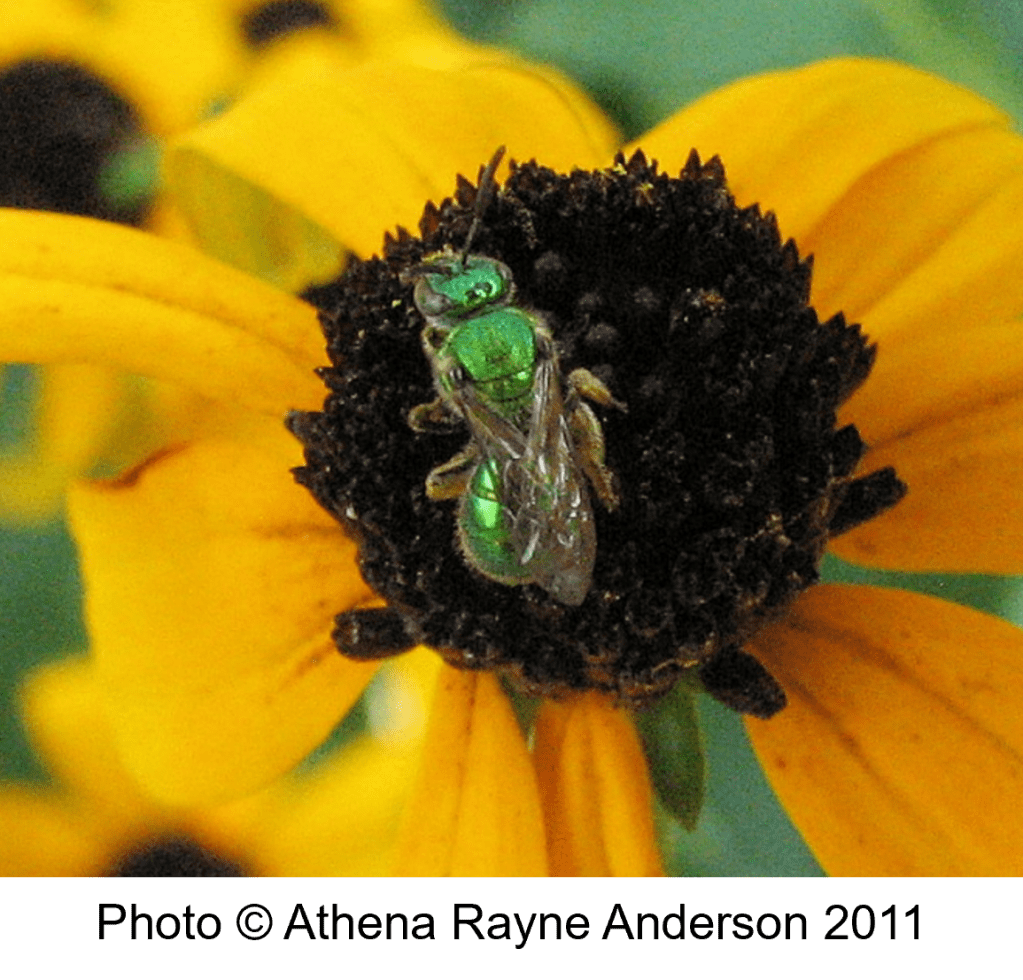
“Sweat” Bees
Family Halictidae
There are many species of bees in this family in Georgia. This is one of the most diverse groups we have, in terms of color variation. Some, like the one pictured here, are metallic green. Others in this family are metallic black, and some are brown with pale stripes. These tend to be smaller than honey bees, and have a habit of licking salts off of sweaty human skin, hence their common name. Females have scopae on their hind legs and nest in the ground. These bees visit many flowers, including those that are very small. Species in this family tend to be most active in summer.
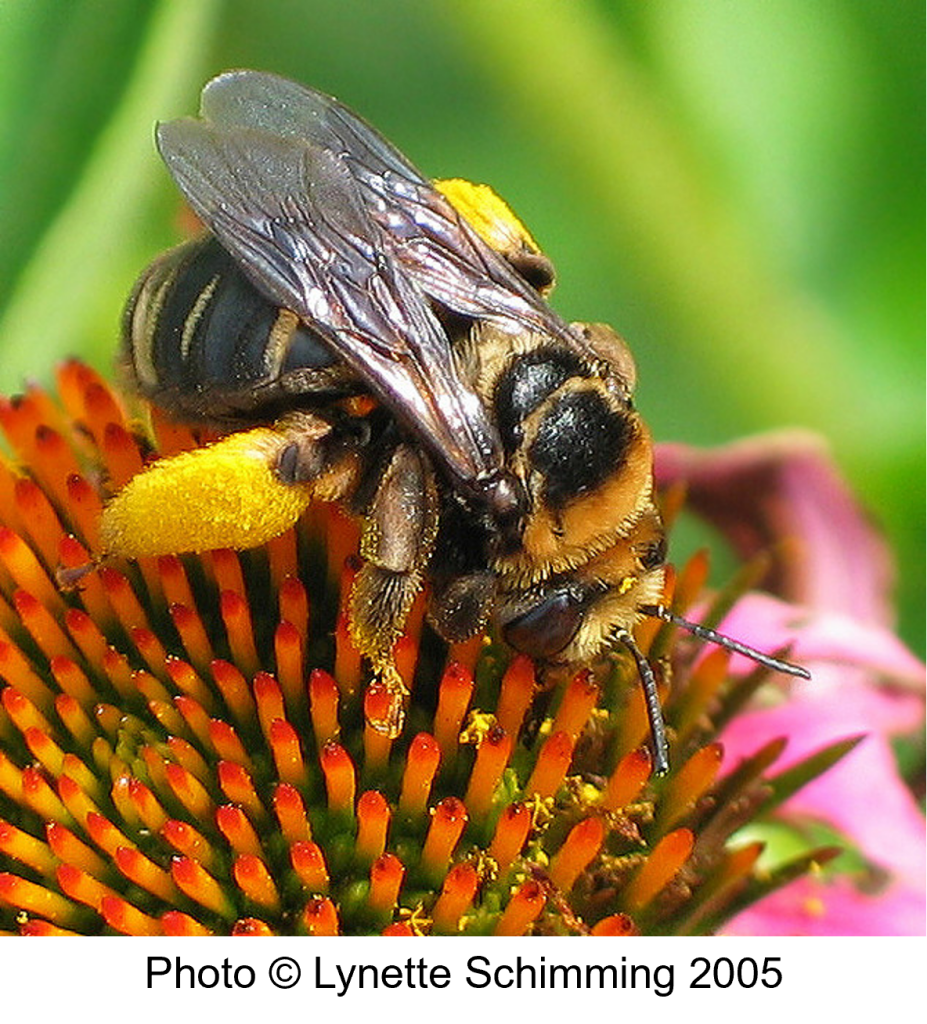
Sunflower Bees
Genus Svastra
Genus Melissodes
These bees are not as common as the others mentioned above. They tend to be larger than honey bees, but smaller than carpenter bees. Females, like the one pictured here, have scopae on their hind legs- this one is carrying a load full of yellow pollen. Sunflower bees are only active when their choice flowers, sunflowers, are blooming. When sunflowers are in full bloom, these bees are very abundant. Females nest in the ground, sometimes directly underneath sunflower plants. Males defend territories, similar to male carpenter bees.
| Download and use of images from this site is a violation of copyright law and legal action will be pursued, unless permission has been granted by the author. All images are copyright Athena Rayne Anderson unless otherwise stated. |

 Athena Rayne Anderson
Leave a comment